THE LOST "BLUE CAR"

Updated: Apr 24
"A Tribute to Jim Wangers' 1964 GTO 'Test Car' built for Car and Driver March 1964"
CHAPTER 1 Greg Raymond

The story is familiar to anyone in the Pontiac community: the Muscle Car era truly began in 1964, when Pontiac chief engineer John DeLorean, along with Russ Gee and Bill Collins, transformed the newly redesigned Tempest into the now‑legendary Pontiac GTO.
While evaluating the 1964 Tempest, a car originally conceived as a four‑cylinder economy model, DeLorean noticed something important. The optional 326ci V8 shared the same external dimensions as every Pontiac V8. That meant the larger 389ci V8 from Pontiac’s full‑size lineup would drop right in. With no physical differences to prevent the swap, the team installed the 389 into the Tempest platform.
And with that simple, brilliant act, the GTO was born, and the Muscle Car era roared to life.
Why Recreate the “Lost Blue Car”?
This is where the story gets interesting. Anyone who has read Jim Wangers’ 2003 book Glory Days: When Horsepower and Passion Ruled Detroit knows there was far more happening behind the scenes.
Drawing on his 45‑year career in Detroit, most notably at the advertising agency McManus, John & Adams, which held Pontiac’s advertising account, Wangers explained how automotive brand building differs from traditional consumer branding. He detailed how to position a car for maximum promotional impact, how to avoid marketing missteps, and how to cultivate a lasting brand identity. In Pontiac’s case, the mission was unquestionably accomplished.
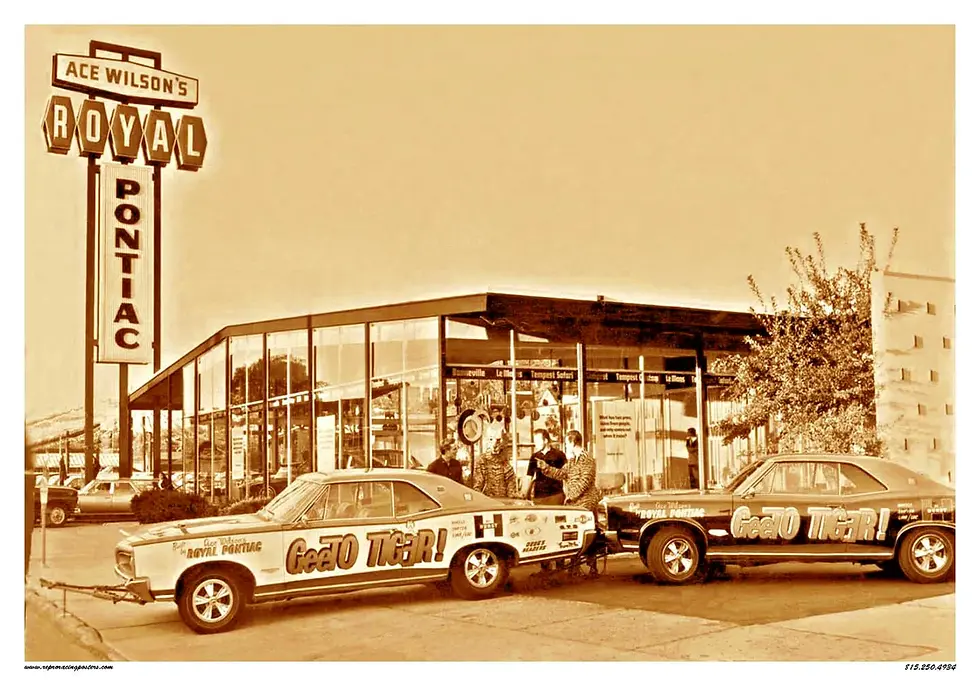
Royal Pontiac and the Car & Driver Test Cars
In Chapter 8, “The Tiger Learns to Roar,” Wangers describes in detail the two GTOs prepared for the March 1964 issue of Car and Driver. Working with his friends at Ace Wilson’s Royal Pontiac in Royal Oak, Michigan, Wangers oversaw modifications to both cars before they were shipped to Daytona Beach for testing in late December 1963.

Royal Pontiac was already famous for its Royal Bobcat performance packages, dealer‑installed combinations of parts, tuning adjustments, and speed equipment that transformed any Pontiac into a dominant street machine.
This brings us back to the "Why"? – Why build a Tribute to a so called "Lost Blue Car?" As the story was archived in the book, told many times to me personally by Jim Wangers himself and substantiated by the likes of Dave Anderson and the rest of the California based Pontiac family, two cars were built and modified by Royal Pontiac for the Car and Driver test sessions. One Red Car and one Blue Car.
The Blue Car A Nocturne Blue pilot‑line Sports Coupe with no production VIN. It featured a 348‑hp Tri‑Power engine, wide‑ratio 4‑speed, 3.55 Safe‑T‑Track rear end, power brakes with metallic linings, and manual steering. It was used for street driving, road course testing, and skidpad evaluation.
The Red Car A Grenadier Red GTO equipped with the same 348‑hp Tri‑Power engine but fitted with a close‑ratio 4‑speed and 3.90 Safe‑T‑Track rear end. Built specifically as a Royal Bobcat, it received a full list of documented performance modifications and was used exclusively for acceleration testing. It had power steering and no power brakes.
Both cars carried Royal Bobcat emblems on their rear sail panels, this "labeled" them as Royal Bobcats This means that they were [assumed to be ... ] stock GTO's with a 389ci engine and the following Royal Bobcat changes:
Royal Bobcat Modifications
The Royal tuning package included:
Carburetion: All three carburetors re‑jetted to .069 for maximum acceleration (vs. the stock .066 center / .073 outboard setup).
Throttle Linkage: A progressive‑action linkage for smoother street manners and more precise control.
Ignition: Distributor modified to limit centrifugal advance to 7° (14° crank), with initial timing set at 20–22°, producing 34–36° total advance by 3600 rpm—dramatically improving low‑end response.
Compression Enhancements: Heat riser blocked, thin 421 Super Duty head gaskets installed, and Champion J‑10Y plugs used without gaskets to raise compression further.
Valve Train: Fiber‑insert rocker arm locknuts allowing hydraulic lifters to behave like solids at 90% bleed‑down.
As described in chapter 8 in Jim's book "Glory Days", – "We agreed to supply two Pontiac GTO's, one a stock Sports Coupe with standard suspension, a 348 horsepower Tri-Power engine, a wide-ratio 4-speed gearbox, and a limited-slip 3.55:1 rear end. We chose to use a "pilot line car," thus it had no production VIN number. That car, known as "The Blue Car" since it was painted Nocturne Blue, was to be used for street driving and for road course and skid pad testing. The second GTO which became known as "The Red Car" since it was painted in Grenadier Red, also had the 348 Tri-Power engine, but used a close-ratio 4-speed, and a 3.90:1 limited-slip rear end. We built it as a Royal Bobcat specifically for the test, and provided Car and Driver with a complete information sheet detailing exactly what modifications had been made. "The Red Car" was set up exclusively for acceleration testing." The Blue Car, having been set up for street driving and for road course and skid pad testing included Power brakes with Metallic linings and manual steering.

Telling the Cars Apart
In an effort to keep it brief ... It's the differences between the two cars, however subtle, paint the true picture. It is important to note that of the nine photographs that were part of the March 1964 Car and Driver article, only two were of "The Red Car." This was this engine shot above, deciphered due to the lack of power brakes and the addition of power steering, as seen in the photograph. And the shot of an acceleration run as seen below.
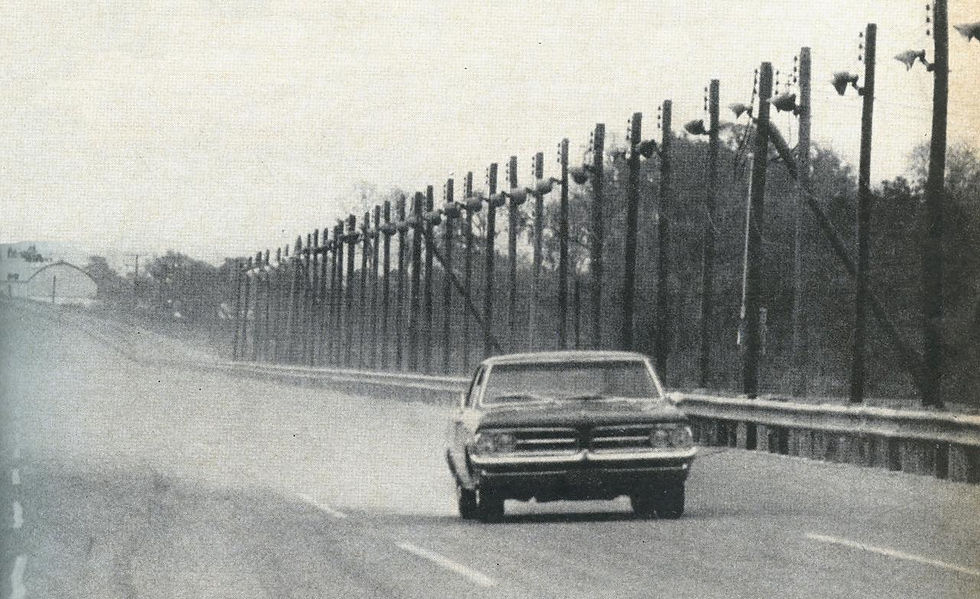
By contrast, The Blue Car had a front‑fender antenna and, according to Wangers’ photo notes, 11 Pages into the photo section of "Glory Days", Wangers reports that a front fender mounted rear view mirror was on "The Blue Car."
no exterior rear‑view mirror, despite earlier assumptions that it carried a front‑fender mirror.
These subtle differences are key to understanding which car appears in each period photograph.

Why Build a Tribute?
Because the Blue Car, the pilot‑line GTO that helped launch the Muscle Car era, no longer exists. Its story survives only through Wangers’ accounts, the memories of Pontiac insiders like Dave Anderson, and the scattered documentation from the 1963–64 test program.
Recreating the “Lost Blue Car” is a way to preserve that history, honor Jim Wangers’ legacy, and bring back to life one of the most important pre‑production GTOs ever built.
Over the coming months, we will chronicle the build and continue exploring the historical record as we recreate this long‑lost test car - a tribute to Jim Wangers’ original 1964 Blue GTO.


Comments