Engine & Front Clip

"A Tribute to Jim Wangers' 1964 GTO 'Test Car' built for Car and Driver March 1964"
CHAPTER 21 Greg Raymond

Well, as they say... as soon as you get too confident, the goal will be harder to achieve. We did miss the debut showing at the San Marino Motor Classic, as well as the POCI National convention. But we didn’t stop progress as if we were defeated!

We started with the engine and transmission installation. We went through the transmission to make sure it was tuned up in strength to handle the power of our JBA Speed Shop built 389ci Tri-Power. The heart of the Blue Car, now with more power than the power-plant that had stunned Car and Driver with its explosive acceleration was ready to take its rightful place.

The engine installation went shockingly effortless with the front end unassembled we mated the transmission externally and installed the assembly as one complete unit. The motor mounts lined up instantly, the transmission cross member slid into position without a millimeter of resistance, and the Tri‑Power intake cleared the firewall and brake booster with textbook spacing. When the final bolts were tightened, it felt less like an installation and more like a reunion! The engine belonged in the chassis, and the chassis welcomed it without a single complication.
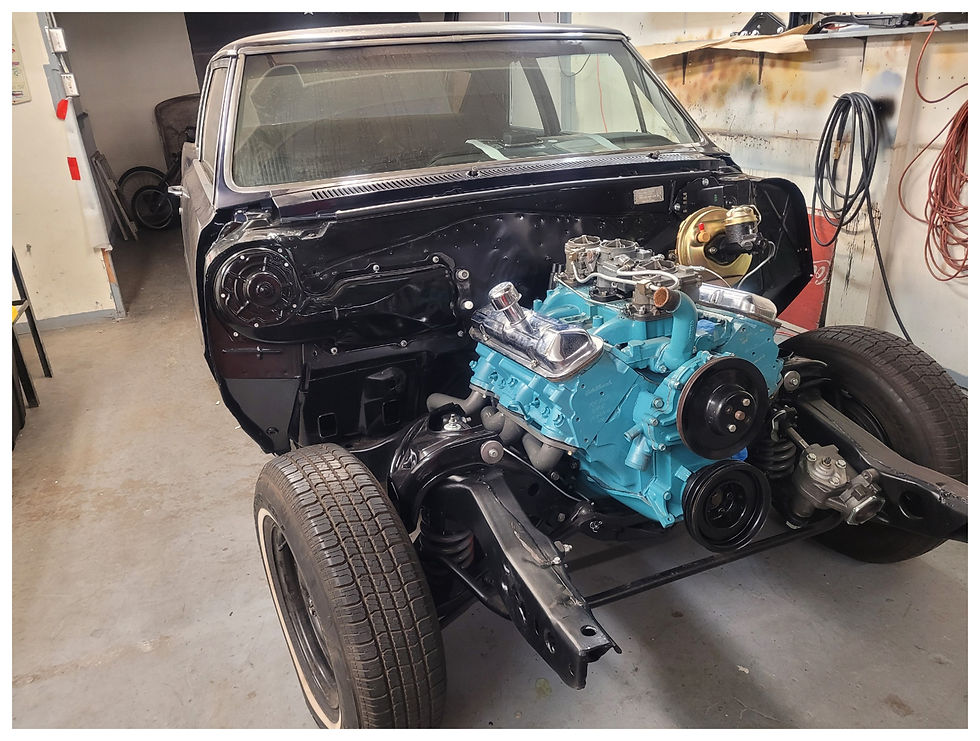
Reassembling the front clip of the 1964 GTO Blue Pilot Car was one of the most revealing stages of the entire restoration. Patterson’s Speed and Kustoms mandated we showcase just how precisely Pontiac’s pilot‑line craftsmen had originally built the car for the Car and Driver test.

Unlike mass‑production GTOs, which often required persuasion to align their sheet metal, the Blue Car’s front structure accepted its components with a level of accuracy that felt engineered. The radiator support, inner fenders, and core structure locked into place with crisp, factory‑sharp tolerances, setting the stage for the dramatic moment when the iconic front fenders were reunited with the chassis.

The fenders themselves were a study in early1964 pilot‑car construction. Each mounting flange, each contour line, and each stamped detail carried the subtle differences that restorers recognize as pre‑production traits. When lifted into position, the fenders settled onto the car with a precision that bordered on uncanny, bolt holes aligned without drift, gaps fell into place without shims, and the crown of each panel matched the curvature of the cowl exactly as it had in 1964. Even the lower dogleg sections, notorious for fighting alignment on production cars, seated themselves cleanly against the rocker panels. It was as if the car remembered how it had been assembled the first time.

The hood was next, and its installation became one of the defining moments of the reassembly. Early GTO hoods are large, heavy, and prone to twisting, yet the Blue Pilot Car’s hood behaved like a perfectly balanced component. When lowered onto the hinges, it settled into its factory geometry with almost no adjustment.

The leading edge met the fenders with a razor‑straight seam, the rear corners aligned with the cowl without binding, and the center ridge flowed seamlessly into the nose of the car. Even the latch mechanism, often a source of frustration, engaged smoothly, snapping shut with the confident, mechanical click that Pontiac engineers would have expected during magazine testing.

The completed front end, fenders, hood, and the freshly mounted 389 transformed the Blue Pilot Car from a bare structure into a recognizable machine. The car’s face returned, its stance settled, and its identity re‑emerged with unmistakable presence.

For the first time since the restoration began, the Blue Car looked ready to breathe again. And with the Tri‑Power bolted in place exactly as it had been in 1964, the car stood poised to reclaim the performance legacy that helped launch the American muscle‑car era.


Comments