SIMPLY "DASHING"

Updated: May 18
"A Tribute to Jim Wangers' 1964 GTO 'Test Car' built for Car and Driver March 1964"
CHAPTER 18 Greg Raymond
Working with perfectionists is a remarkable experience, time‑consuming, yes, but remarkable all the same. The team at Patterson’s Speed & Kustom decided the Blue Car’s dash bezel deserved nothing less than an exact, factory‑faithful recreation. What followed was a series of steps so meticulous, so far beyond anything I’d ever seen, that the process demanded to be documented.

The original dash bezel, shown here after 62 years of service, had suffered all the typical aging. The chrome was nearly gone. The Tahoe Blue (often called “Dash Insert Blue”) anti‑glare accents had survived but were inconsistent. And the Dark Aqua “Code 217” finish, correct for a standard LeMans, needed to be replaced with the Blue Car’s original Black “Code 214” finish.
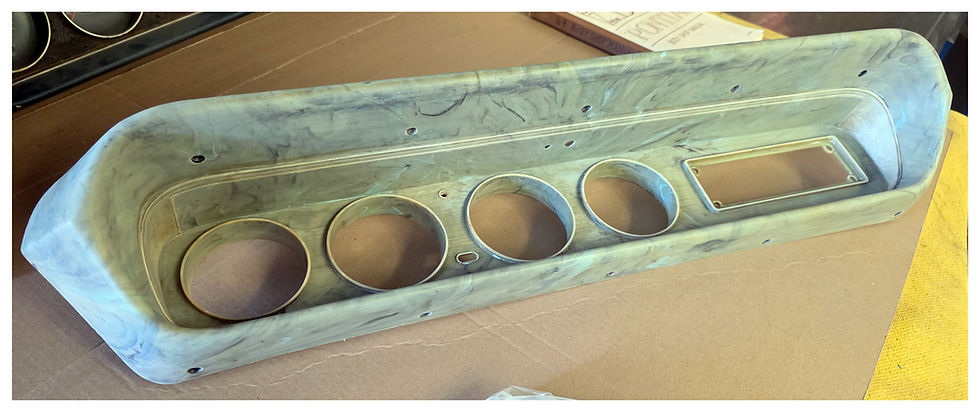

Archiving every step of this restoration has been one of the most rewarding parts of the project, and this stage revealed a fascinating piece of GM manufacturing history. After stripping the bezel with good old Easy‑Off oven cleaner, we took it all the way down to the raw injection‑molded plastic. Only then did we discover the multicolored resin pellets used in the original molding process, something you’d never see unless you performed a full autopsy like this.


Rebuilding the Finish
We began with a fresh coat of the correct low‑gloss, dead‑flat black, essentially a 0% gloss finish. It’s not satin, not semi‑gloss, and definitely not interior vinyl paint. It’s closer to a “camera‑flat” black. To replicate it, we used SEM Trim Black 39143, which laid down beautifully.

Then came the most surprising part of the entire process.
Anyone who has restored a classic car has probably researched spray‑chrome systems or vacuum‑metalizing... both expensive, both finicky. And we’ve all been disappointed by the cheap “chrome” spray paints that never live up to their labels.
Until now.
Revell has developed a spray‑chrome paint that is genuinely impressive. At over thirty dollars for a 5‑ounce can, it isn’t cheap, but the results are stunning. For the first time, a spray‑chrome product actually delivered the crisp, reflective finish we needed.

The Finishing Touch: The Swirled Aluminum Insert
With the chrome areas complete, we reinstalled the restored factory gauges and turned to the dash insert, the signature element that sets the 1964 GTO apart from the Tempest and LeMans. The original insert was a thin .03" aluminum panel, engine‑turned to create the iconic swirl pattern.

The reproduction part available today is essentially a decal, not aluminum, and nearly impossible to apply cleanly. Worse, it doesn’t fit a 62‑year‑old, heat‑cycled plastic bezel with any accuracy.
So, naturally, the Patterson team went the extra mile.

Using a sheet of .03" stainless steel and the reproduction decal as a template, they created a perfect, hand‑crafted reproduction of the original Pontiac insert. The result is breathtaking... an exact recreation of what Pontiac engineers designed in 1964.
This is the kind of detail that transforms a restoration into a tribute. And this bezel? It’s a work of art.


Comments